
several graphs, one map, no trees
2025 in books (stats, recs, reading-related hopes for the new year)

Happy New Year, everyone! This post, sponsored by Goodreads and Google Sheets, recaps my 2025 reading. It will be very self-indulgent :) Thanks for following along!
In 2025, I read 76 books, exactly one more than my target and 18 more than 2024.1 That’s about 6.33 books per month, but my actual reading habits varied widely. I finished the most books in January (15) and the least in February (2).
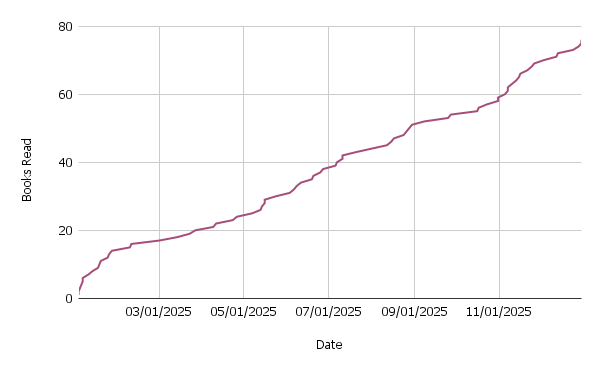
On average, it took me 8.17 days to read each book, but median 4, since I read 20 of them in one day each and 54 in a week or less each. The longest time it took me to read something was 65 days for Sayaka Murata’s Life Ceremony, a collection of stories I started for 21L.450 (Global Environmental Literature) and finished on my own time.
Reading speed correlated to page count, but not super strongly. Across all books, the mean and median page counts were 284.8 and 256, respectively. That first number lowered to 218.6 when I only counted one-day books, but then lowered again to 135.7 when I counted books read in a week or less, reflecting my (bad?) habit of lying in bed and reading an entire book to procrastinate cooking dinner. The longest book I read was 2666 (912 pages, 45.6 per day), and the shortest was Hannah Sullivan’s Three Poems (80 pages in nine days).
44 books were fiction, 18 nonfiction, 11 poetry, and three (Reality Hunger, Exercises in Style, and Bluets) weird enough that I classified them as “hybrid.” Within fiction, 37 were novels, five short story collections, and two plays. Thanks to 2666 and Middlemarch, the average novel length was 319.1 pages, if that says anything.
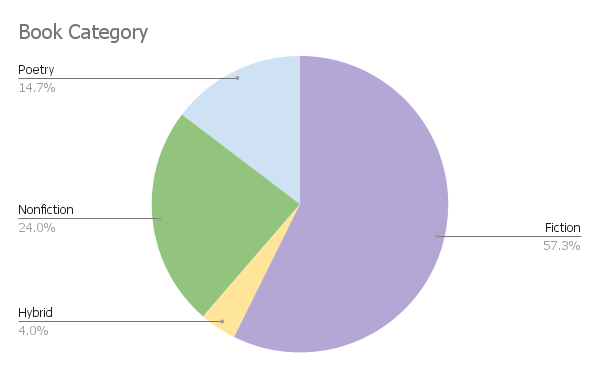
At the beginning of the year, I said I wanted to read 25 nonfiction books, so I’m a little disappointed that I got off track. I also wish I had read more plays. However, I’m quite pleased with my poetry reading, a lot of which is not reflected by this chart (yay class and Google!), and feel eh-to-good about the fiction.
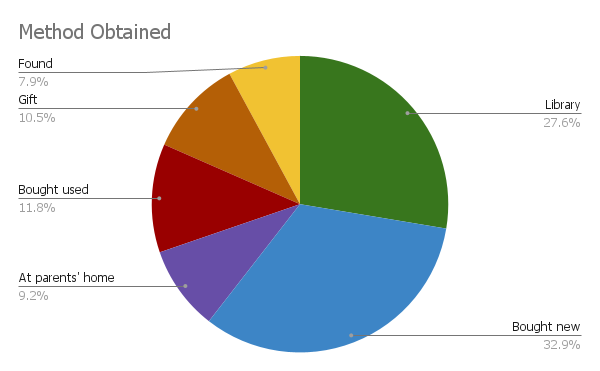
Most of those 18 nonfiction books came from MIT’s library system, which was the second-highest contributor to my reading list this year. Overall, I bought a lot more books new than I probably should have, but that was still less than a third of the total thanks to the library, the exceptional used bookstores and sidewalk shelves of Cambridge/NYC/Burlingame, and the wonderful family and friends who lent or gifted me books. Also, I read mostly physical books (67 out of 76), but I was grateful for my Kindle while in California.
I read 21 works in translation. My original goal was to read “at least 15 [books] by international authors” (by which I think past me meant non-Anglosphere works) so I’m happy to have surpassed that target. However, a good six of these pieces were by Roberto Bolaño, on whom I’m writing a thesis. Plus, Italo Calvino claimed three more, then Haruki Murakami and W.G. Sebald each took two, so more than half of the 21 translated works came from only four authors.
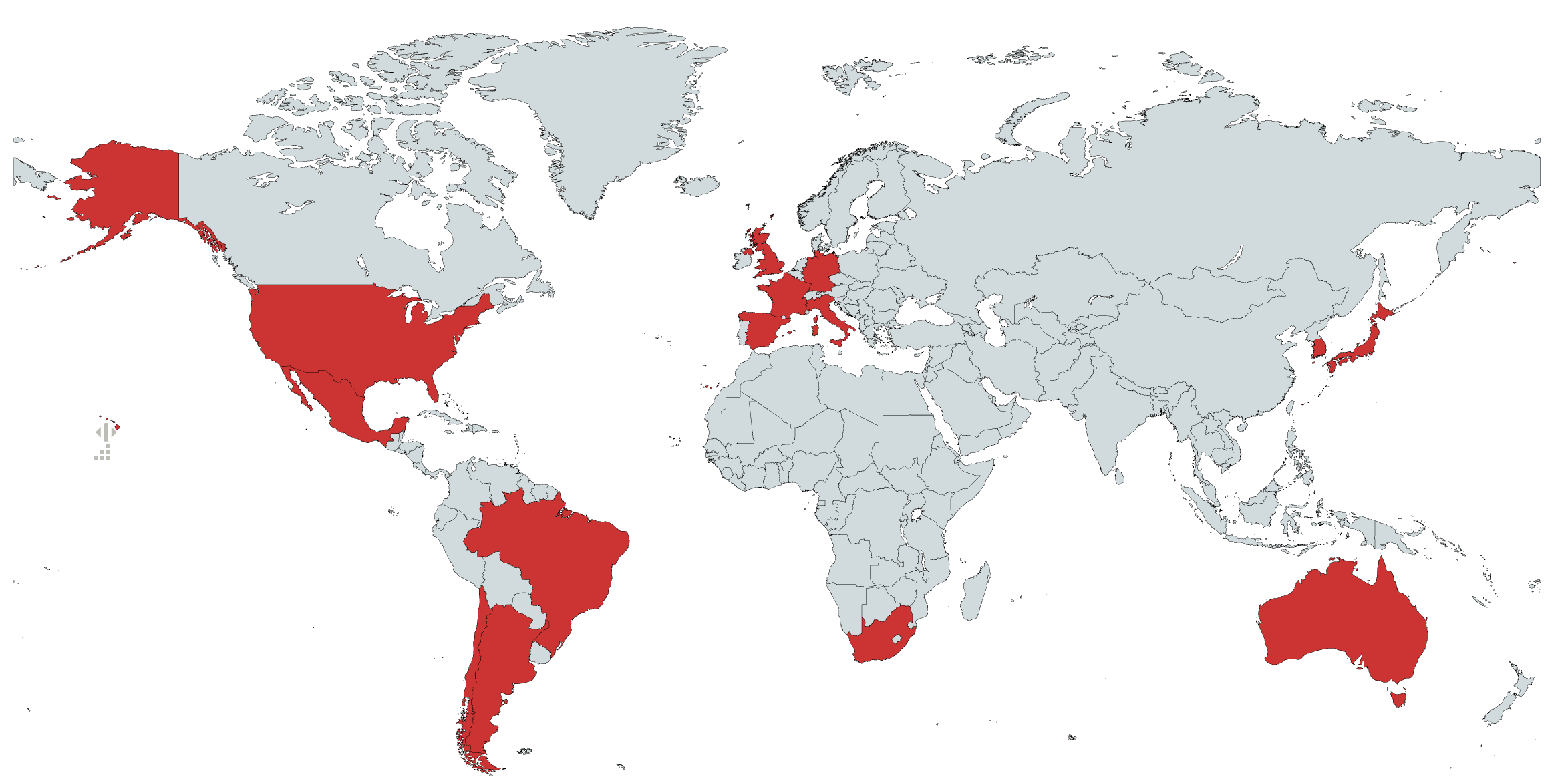
On the bright side, when you take all texts into consideration, I read books originally written in eight different languages (English, Spanish, Italian, German, Japanese, Korean, Portuguese, and French) and from every continent!2 (Across all categories, excepting introductions and the like, every work had a single author, i.e., no anthologies. ) Still, when I look at the map below, I feel pretty disappointed in the lack of geographic or linguistic diversity. Nothing from RUSSIA? CHINA? ANYWHERE IN AFRICA OTHER THAN SOUTH AFRICA? Sabine!
And I only read three books published before 1900 — Richard II (Shakespeare, so “pub date” is iffy, but let’s say 1595), Vilette (1853), and Middlemarch (1871) —which falls, uhh, significantly under my goal of 20. The mean and median dates of publication were 1985.2 (lol?) and 1999.5 (lmao?), respectively, and 38 — i.e. exactly half — of the books were published this century.3 These numbers were quite disappointing, as I’d envisioned 2025 as a year of “the classics.” Oh well.
Let’s get to the squishy subjective part! I gave six books two out of five stars, 29 three, another 29 four, and 12 five, which averages to 3.618/5 stars.4 At any given time, the average rating up to that point remained approximately constant, hovering around 3.5 stars and suggesting that I’ll never be a super tough customer.
In what follows, I’ll list all of the books by rating and give blurbs/impressions/reasons to read for the four- and five-star ones.
Two stars
The Most by Jessica Anthony
Forbidden Notebook by Alba de Céspedes (trans. Anna Goldstein)
Bluets by Maggie Nelson
After Claude by Iris Owens
My Year of Meats by Ruth Ozeki
The Hanging on Union Square: An American Epic by H.T. Tsiang
Three stars
The Convalescent by Jessica Anthony
Spent: A Comic Novel by Alison Bechdel
How to Read and Why by Harold Bloom
Villette by Charlotte Brontë
Disgrace by J.M. Coetzee
Sailing Alone Around the Room: New and Selected Poems by Billy Collins
Democracy and Its Critics by Robert Dahl
City of Quartz: Excavating the Future in Los Angeles by Mike Davis
Aspects of the Novel by E.M. Forster
Pedagogy of the Oppressed by Paulo Freire (trans. Myra Bergman Ramos)
Speak by Louisa Hall
Sentience: The Invention of Consciousness by Nicholas Humphrey
Klara and the Sun by Kazuo Ishiguro
All Fours by Miranda July
The Vegetarian by Han Kang (trans. Deborah Smith)
Collected Poems by Jane Kenyon
Palaces for the People: How Social Infrastructure Can Help Fight Inequality, Polarization, and the Decline of Civic Life by Eric Klinenberg
The Princess of 72nd Street by Elaine Kraf
Angels in America by Tony Kushner
Collected Poems by Philip Larkin (ed. Anthony Thwaite)
The New New Thing: A Silicon Valley Story by Michael Lewis
The City & the City by China Miéville
Norwegian Wood by Haruki Murakami (trans. Jay Rubin)
Exercises in Style by Raymond Queneau (trans. Barbara Wright)
Slow Dance by Rainbow Rowell
Richard II by William Shakespeare
Reality Hunger: A Manifesto by David Shields
Three Poems by Hannah Sullivan
The Swan Book by Alexis Wright
Four stars
The American Way of Poverty: How the Other Half Still Lives by Sasha Abramsky
Compelling and necessary, especially now.
By Night in Chile, Distant Star, Amulet, and Antwerp by Roberto Bolaño (first three trans. Chris Andrews, last trans. Natasha Wimmer)
These are all great (more on Bolaño later), but I would particularly recommend Antwerp, which houses the best prose poems I’ve ever read. By Night in Chile is the most difficult of the four, I think.
Six Memos for the Next Millennium, Cosmicomics, and Invisible Cities by Italo Calvino (first trans. Geoffrey Brock, other two trans. William Weaver)
I like Calvino, but as I said recently to Avery, he’s kinda like a dog/small child that knows they’re really cute and tries to do extra tricks to seem cuter. When he gets too precious, I get annoyed. Still, objectively excellent.
Invisible Man by Ralph Ellison
Can’t believe I only just read this. Really good.
The Fiery Trial: Abraham Lincoln and American Slavery by Eric Foner
Thoughtful exploration of Lincoln’s changing attitudes towards slavery and race.
Hymns of the Republic: The Story of the Final Year of the American Civil War by S.C. Gwynne
I’d like to learn more about the Civil War (see above); this was a fast-paced and well-researched starting point.
Collected Poems by Robert Hayden (ed. Frederick Glaysher)
It’s weird to me that Hayden isn’t taught much in middle or high school (as far as I can tell) — his language is both highly approachable and formally unimpeachable.
The Remains of the Day by Kazuo Ishiguro
I hated Never Let Me Go and, because of that, avoided anything Ishiguro for ages. Wrong choice; this was excellent.
The Death and Life of Great American Cities by Jane Jacobs
She’s so funny and mean! I’m really glad that I became inexplicably urban planning-pilled earlier this year and got to discover this classic.
The Heart Is a Lonely Hunter by Carson McCullers
Why didn’t we read this in high school? So bittersweet.
Sputnik Sweetheart by Haruki Murakami (trans. Philip Gabriel)
I think this is my favorite of Murakami’s that I’ve read. Sumire is lowkey one of my favorite characters ever.
Life Ceremony by Sayaka Murata (trans. Ginny Tapley Takemori)
Recommend for people who wished Bunny by Mona Awad was actually good. Unlike most contemporary writers, Murata pulls off speculative fiction.
I Must Be Living Twice: New and Selected Poems by Eileen Myles
Urbane, physical, aggressively smart.
Mumbo Jumbo by Ishmael Reed
Just quite awesome. I don’t remember much of the reading experience other than belly laughter.
The Rings of Saturn by W.G. Sebald (trans. Michael Hulse)
Difficult to describe other than “you should probably read this.” Webbed. Thanks to Dr. Lee for the recommendation back in high school.
frank: sonnets by Diane Seuss
I love poetry that earns its rawness. When I went to Acadia with my roommates and Sri, we sat on a beach eating ham sandwiches that were mostly mayo, and I circled like every word of a couple of Seuss’s poems in pencil as I watched water burst through the sand.5
How to Be Both by Ali Smith
Gave this to my mom for Christmas. Really lovely and joyful.
On Women by Susan Sontag
Thanks to Julia for the gift. Sontag is much smarter than anyone else, I think.
Poems by Wallace Stevens (ed. Samuel French Morse)
I originally gave this three stars, then remembered how much I love some of his poems. Stevens is underrated as a sensualist and overrated as a philosopher, in my opinion. Peter Quince at the Clavier is still the best poem of all time.
The White Orchard: Selected Interviews, Essays, and Poems by Arthur Sze
My dad gave this to me for my birthday — before Sze was named as the new Poet Laureate, and before I interviewed him in The Tech, which is maybe my favorite moment of my college career. It was super interesting to read about his poetics and then see them in action, especially in the essay that dealt with revisions of the titular poem.
The Loneliness of the Long-Distance Cartoonist by Adrian Tomine
I don’t know if this book is actually good or if I just read it when I needed to. Doesn’t really matter.
Girl with Curious Hair, Oblivion, and Both Flesh and Not: Essays by David Foster Wallace
I realized at the beginning of 2025 that I kept telling people DFW is one of my favorite authors, but I haven’t read a sizable minority of his work. Discovering him anew is always such a joy.
Five stars
Giovanni’s Room by James Baldwin
Thanks Avery for lending/recommending. We use the word masterful too often, but Baldwin reminds us what it really means, and what love’s all about.
The Savage Detectives and 2666 by Roberto Bolaño (trans. Natasha Wimmer)
I read TSD in Burlingame and felt my world explode, no exaggeration. Bolaño knew storytelling like no other. Later, reading 2666, first for fun and then because I realized I wanted to write my undergraduate thesis on it, I had a similar experience. I cannot recommend either book enough, although I’d suggest that you start with The Savage Detectives.
Ficciones by Jorge Luis Borges (trans. Anthony Kerrigan and Anthony Bonner)
Another classic borrowed from Avery. Felt myself grinning like crazy throughout this book. Borges knows he’s smarter than you, and you like it. I am literally always thinking about how he spatializes the archive and archives space.
Middlemarch by George Eliot
Best book of all time, maybe? Maybe yes? Yes. To quote my own Goodreads review: “Eliot tackles some of the most universal questions — who should we marry and what do we owe them; how do we balance the obligations of faith, society, and family; what do our choice of career and our socioeconomic background have to do with our relationships; etc —but her characters are so perfectly constructed that they seem capital-p People with meaningful real inner lives beyond the page.” So goated.
The Sound and the Fury by William Faulkner
Another incredibly great book I’m mad at myself for not reading until this year, when I decided to use it to keep me awake on the plane ride to SF. Wowowow. Hugely exciting and inventive and compassionate.
All of It Singing: New and Selected Poems by Linda Gregg
Gregg’s poetry is full of — I don’t know, “spirit” feels wrong, “life” feels wrong, what I mean is that it glows. She was the real deal. Seemingly simple and always, always heartbreaking.6
The Passion According to G.H. by Clarice Lispector
Another recommendation from Dr. Lee. I felt incredibly confused and exhilarated throughout. Just read it.
Graphs, Maps, Trees: Abstract Models for a Literary History by Franco Moretti
Okay, controversial pick, but ahh! Wow! I did not know that you were allowed to do this with books; I did not know that you were allowed to think how I sometimes want to think. Graphs, Maps, Trees: a key.
Austerlitz by W.G. Sebald
Better than The Rings of Saturn (which was, as I mentioned, already great) because it almost made me cry. I walked up and down the hills of Coyote Point reading this book and thinking about Austerlitz and his rucksack.
Enlivenment: Toward a Poetics for the Anthropocene by Andreas Weber7
Another book that felt like permission to write more expansively. Some of the loveliest prose I’ve ever seen outside of fiction, but it’s still rigorous biology and philosophy. Wish I had bought instead of borrowed from the library.
Selected Poems by William Carlos Williams (ed. Charles Tomlinson)
Thanks to Paco for the gift. I got really into WCW in the spring, but I didn’t have the opportunity to read an entire book of poems until the summer, when Williams swept me off my feet with his candid love for humanity. No ideas but in things.
Writing those blurbs, I realized that 2025 really was a fun year for books. I hope 2026 will surpass it. In particular, this time, I want to read 90 books (approximately one every four days), including at least 30 works in translation from a wider range of languages/countries and at least 20 books written before 1900. I don’t really care about length, but I do think it would be good for my attention span to read at least five books that are 700 pages or more.
In my nonfiction readings (hopefully around 25), I would like to learn more about the Civil War and Reconstruction; at least a couple classic philosophy texts; the lives of some of my favorite authors; Russian formalism, post-/structuralism, and narratology; the more artistic side of architecture and urban design; theories of “Latin American” identity; Black poetics; religion in general; and modern Taiwanese and Singaporean history. To name a few. Don’t know what books exactly will fit the many bills, excited to find out.
The only novels I feel that I absolutely must read in 2026 are Ulysses and Moby-Dick. I hope also to finally tackle Dostoevsky’s big books, something of Tolstoy, and at least Swann’s Way from Proust. In the process of thesis-ing, I’ll probably end up reading Hopscotch and more of Borges. Also going to check out Cormac McCarthy plus read more of Toni Morrison and Thomas Pynchon, because duh. I want to actually read Flannery O’Connor’s short stories this year too. And more plays, of course Shakespeare but also Ibsen and Brecht and Chekhov and...
For poetry, more older stuff (Donne! Keats!) and more properly long poems. Omeros and Paterson are sitting on my shelf in Cambridge and I’m so hype! Song of Myself is calling my name! Also really want to reread Paradise Lost, which satisfies both criteria, but I need to steal my copy back from Avery for that. Slightly less hype for the Divine Comedy, as my translation sucks, but I’m told it’s “one of the greatest works of literature of all time,” so maybe I’ll find a better one. Homer someday.
Next semester (the last of college!), I’m planning to take classes on Bleak House, Romanticism (especially Blake and Shelley), and the Canterbury Tales. I’m very excited to go crazy over a couple British guys. And perhaps a couple more courses, who knows.
So much to do, so much to read. And write. And think.
It’ll be a great time.
I briefly moved my goal to 80 books, before Middlemarch and the 18.03 ASE took up half of December.
Other than Antarctica, haha.
I wouldn’t place a ton of stock in the figures from this sentence, though, since poetry, short story, and essay collections often have publication dates that differ pretty substantially from their contents’. Still seems worrisomely skewed towards the contemporary.
My rating system is pretty generous and goes approximately: five for stunning/new favorite, four for good or very good, three for fine, two for “I didn’t like it but people I respect do,” and one for “I didn’t like it and I cannot see how someone could.” Luckily, there were no one star ratings this year!
I wasn’t sure if he published this first in English or German, so I counted it as one of the translated works.
woah this is so detailed and so based
+1 on locking in on Ulysses in 2026 because i need to also (my friend is a james joyce nerd and she never fails to hype him up)
also i will never not praise anna karenina, its so worth it (once you figure out the 2-3 different names for each character lmao)
agreed that the 21L offerings look so iconic...i need to lock in...TOO MANY THINGS TO TAKE RAHHH </3